JN0-683 - Newest Data Center, Professional (JNCIP-DC) PDF Question
Wiki Article
P.S. Free & New JN0-683 dumps are available on Google Drive shared by TrainingDump: https://drive.google.com/open?id=1UNq8wZC-q3AsbNDOogbmAav7N7ntyfhY
More successful cases of passing the JN0-683 exam can be found and can prove our powerful strength. As a matter of fact, since the establishment, we have won wonderful feedback and ceaseless business, continuously working on developing our JN0-683 test prep. We have been specializing JN0-683 Exam Dumps many years and have a great deal of long-term old clients, and we would like to be a reliable cooperator on your learning path and in your further development. We will be your best friend to help you pass the JN0-683 exam and get certification.
At the fork in the road, we always face many choices. When we choose job, job are also choosing us. Today's era is a time of fierce competition. Our JN0-683 exam question can make you stand out in the competition. Why is that? The answer is that you get the certificate. What certificate? Certificates are certifying that you have passed various qualifying examinations. Watch carefully you will find that more and more people are willing to invest time and energy on the JN0-683 Exam, because the exam is not achieved overnight, so many people are trying to find a suitable way.
Valid JN0-683 Cram Materials - Hot JN0-683 Spot Questions
Our JN0-683 exam questions have the merits of intelligent application and high-effectiveness to help our clients study more leisurely. If you prepare with our JN0-683 actual exam for 20 to 30 hours, the JN0-683 exam will become a piece of cake in front of you. Not only you will find that to study for the exam is easy, but also the most important is that you will get the most accurate information that you need to pass the JN0-683 Exam.
Juniper JN0-683 Exam Syllabus Topics:
| Topic | Details |
|---|---|
| Topic 1 |
|
| Topic 2 |
|
| Topic 3 |
|
Juniper Data Center, Professional (JNCIP-DC) Sample Questions (Q34-Q39):
NEW QUESTION # 34
You are implementing VXLAN broadcast domains in your data center environment. Which two statements are correct in this scenario? (Choose two.)
- A. Layer 2 frames are encapsulated by the source VTEP.
- B. The VNI is a 16-bit value and can range from 0 through 16.777.215.
- C. The VNI must match the VLAN tag to ensure that the remote VTEP can decapsulate VXLAN packets.
- D. A VXLAN packet does not contain a VLAN ID.
Answer: A,D
Explanation:
* VXLAN Overview:
* VXLAN (Virtual Extensible LAN) is a network virtualization technology that encapsulates Layer
2 Ethernet frames into Layer 3 UDP packets for transmission over an IP network. It allows the creation of Layer 2 overlay networks across a Layer 3 infrastructure.
* Understanding VXLAN Components:
* VTEP (VXLAN Tunnel Endpoint):A VTEP is responsible for encapsulating and decapsulating Ethernet frames into and from VXLAN packets.
* VNI (VXLAN Network Identifier):A 24-bit identifier used to distinguish different VXLAN segments, allowing for up to 16 million unique segments.
* Correct Statements:
* C. Layer 2 frames are encapsulated by the source VTEP:This is correct. In a VXLAN deployment, the source VTEP encapsulates the original Layer 2 Ethernet frame into a VXLAN packet before transmitting it over the IP network to the destination VTEP, which then decapsulates it.
* A. A VXLAN packet does not contain a VLAN ID:This is correct. The VXLAN header does not carry the original VLAN ID; instead, it uses the VNI to identify the network segment. The VLAN ID is local to the switch and does not traverse the VXLAN tunnel.
* Incorrect Statements:
* B. The VNI must match the VLAN tag to ensure that the remote VTEP can decapsulate VXLAN packets:This is incorrect. The VNI is independent of the VLAN tag, and the VLAN ID does not need to match the VNI. The VNI is what the remote VTEP uses to identify the correct VXLAN segment.
* D. The VNI is a 16-bit value and can range from 0 through 16,777,215:This is incorrect because the VNI is a 24-bit value, allowing for a range of 0 to 16,777,215.
Data Center References:
* VXLAN technology is critical for modern data centers as it enables scalability and efficient segmentation without the constraints of traditional VLAN limits.
NEW QUESTION # 35
Exhibit.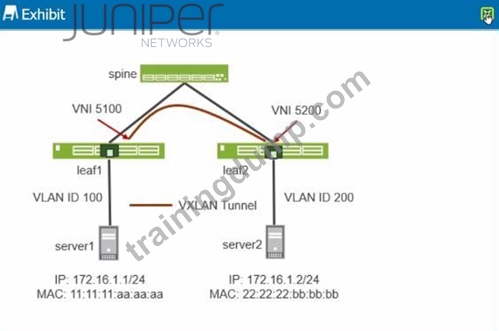
A VXLAN tunnel has been created between leaf1and Ieaf2 in your data center. Referring to the exhibit, which statement is correct?
- A. Traffic sent from server1to server2 will be dropped on leaf1.
- B. Traffic sent from server1to server2 will be tagged with VLAN ID 200 on Ieaf2 and forwarded to server2.
- C. Traffic sent from server1to server2 will be dropped on Ieaf2.
- D. Traffic sent from server1to server2 will be tagged with VLAN ID 100 on Ieaf2 and forwarded to server2.
Answer: B
Explanation:
* Understanding VXLAN Tunneling:
* VXLAN (Virtual Extensible LAN) is a network virtualization technology that addresses the scalability issues associated with traditional VLANs. VXLAN encapsulates Ethernet frames in UDP, allowing Layer 2 connectivity to extend across Layer 3 networks.
* Each VXLAN network is identified by a unique VXLAN Network Identifier (VNI). In this exhibit, we have two VNIs, 5100 and 5200, assigned to the VXLAN tunnels between leaf1 and leaf2.
* Network Setup Details:
* Leaf1:Connected to Server1 with VLAN ID 100 and associated with VNI 5100.
* Leaf2:Connected to Server2 with VLAN ID 200 and associated with VNI 5200.
* Spine:Acts as the interconnect between leaf switches.
* Traffic Flow Analysis:
* When traffic is sent from Server1 to Server2, it is initially tagged with VLAN ID 100 on leaf1.
* The traffic is encapsulated into a VXLAN packet with VNI 5100 on leaf1.
* The packet is then sent across the network (via the spine) to leaf2.
* On leaf2, the VXLAN header is removed, and the original Ethernet frame is decapsulated.
* Leaf2 will then associate this traffic with VLAN ID 200 before forwarding it to Server2.
* Correct Interpretation of the Exhibit:
* The traffic originating from Server1, which is tagged with VLAN ID 100, will be encapsulated into VXLAN and transmitted to leaf2.
* Upon arrival at leaf2, it will be decapsulated, and since it is associated with VNI 5200 on leaf2, the traffic will be retagged with VLAN ID 200.
* Therefore, the traffic will reach Server2 tagged with VLAN ID 200, which matches the network configuration shown in the exhibit.
* Data Center References:
* This configuration is typical in data centers using VXLAN for network virtualization. It allows isolated Layer 2 segments (VLANs) to be stretched across Layer 3 boundaries while maintaining distinct VLAN IDs at each site.
* This approach is efficient for scaling large data center networks while avoiding VLAN ID exhaustion and enabling easier segmentation.
In summary, the correct behavior, as per the exhibit and the detailed explanation, is that traffic sent from Server1 will be tagged with VLAN ID 200 when it reaches Server2 via leaf2. This ensures proper traffic segmentation and handling across the VXLAN-enabled data center network.
NEW QUESTION # 36
Click the Exhibit button. You are troubleshooting a DCI connection to another data center. The BGP session to the provider is established, but the session to Border-Leaf-2 is not established.
Referring to the exhibit, which configuration change should be made to solve this problem?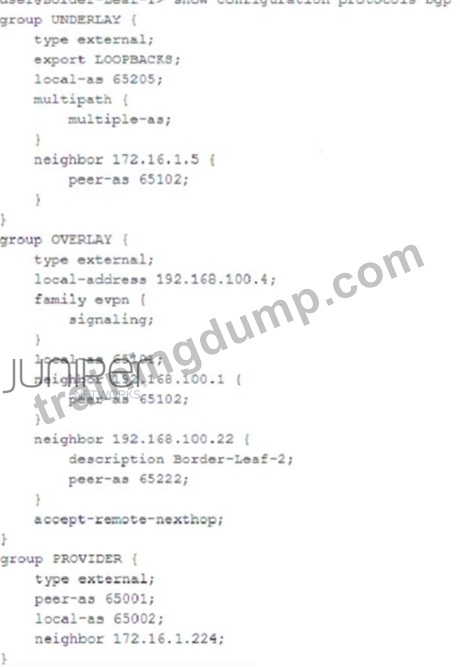
- A. set protocols bgp group overlay export loopbacks
- B. delete protocols bgp group OVERLAY accept-remote-nexthop
- C. set protocols bgp group PROVIDER export LOOPBACKS
- D. delete protocols bgp group UNDERLAY advertise-external
Answer: B
Explanation:
The "accept-remote-nexthop" statement allows the router to accept prefixes with a next hop that is not directly connected, which can cause BGP neighbor sessions to fail if not needed or properly supported.
Removing "accept-remote-nexthop" from the OVERLAY group is a common fix to resolve BGP session establishment issues with EVPN neighbors.
NEW QUESTION # 37
Referring to the exhibit, why is the active source field blank for the entry that uses the
00:0c:29:e8:b7:39 MAC address?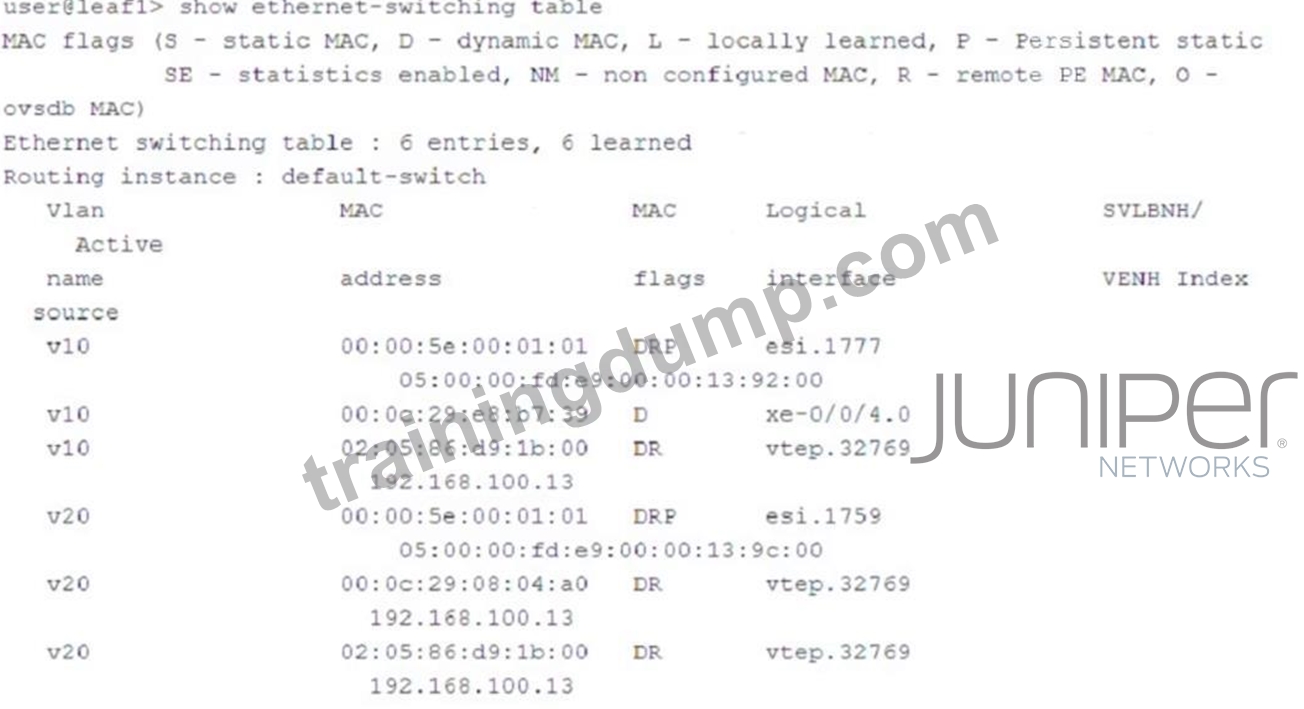
- A. The ARP lookup for this host has failed.
- B. The host for this entry is locally connected to leaf1.
- C. This entry is associated with a multicast EVPN route.
- D. The EVPN route for this host does not have a valid next hop.
Answer: B
Explanation:
In an Ethernet switching table, if a MAC address is learned on a local interface (e.g., xe-0/0/4.0), the active source will be blank since the source is local and not learned via EVPN from another VTEP or remote site.
Remote entries (learned via VXLAN/EVPN) typically display the VTEP information as the active source; local entries do not populate this field.
NEW QUESTION # 38
Whatare two supported methods (or exporting data when using the Junos telemetry interface? (Choose two.)
- A. using REST
- B. using UDP
- C. using gRPC
- D. using SNMP
Answer: B,C
Explanation:
* Junos Telemetry Interface (JTI):
* The Junos Telemetry Interface is a framework that allows network operators to collect real-time telemetry data from Juniper devices. This data can be used for monitoring, analytics, and network automation.
* Data Export Methods:
* Option B:UDP (User Datagram Protocol)is a lightweight, connectionless protocol used for exporting telemetry data quickly with minimal overhead. While it doesn't guarantee delivery, it is suitable for high-speed data transfer where occasional packet loss is acceptable.
* Option D:gRPC (gRPC Remote Procedure Call)is a modern, high-performance method for data export that supports streaming and remote procedure calls, making it ideal for more complex telemetry data use cases.
Conclusion:
* Option B:Correct-UDP is supported for exporting telemetry data.
* Option D:Correct-gRPC is also supported, offering advanced streaming capabilities
NEW QUESTION # 39
......
Generally speaking, the clients will pass the test if they have finished learning our JN0-683 test guide with no doubts. The odds to fail in the test are approximate to zero. But to guarantee that our clients won’t suffer the loss we will refund the clients at once if they fail in the test unexpectedly. The procedures are very simple and the clients only need to send us their proofs to fail in the JN0-683 test and the screenshot or the scanning copies of the clients’ failure scores. The clients can consult our online customer staff about how to refund, when will the money be returned backed to them and if they can get the full refund or they can send us mails to consult these issues.
Valid JN0-683 Cram Materials: https://www.trainingdump.com/Juniper/JN0-683-practice-exam-dumps.html
- JN0-683 Study Test ???? Reliable JN0-683 Exam Papers ???? Reliable JN0-683 Study Guide ???? Open website ⮆ www.practicevce.com ⮄ and search for 《 JN0-683 》 for free download ⏬Reliable JN0-683 Exam Papers
- JN0-683 Valid Exam Discount ???? JN0-683 Valid Test Questions ???? Reliable JN0-683 Source ???? Immediately open ☀ www.pdfvce.com ️☀️ and search for ➥ JN0-683 ???? to obtain a free download ????JN0-683 Valid Test Questions
- Top Features of www.vce4dumps.com Updated JN0-683 Exam Practice Questions ???? ➠ www.vce4dumps.com ???? is best website to obtain { JN0-683 } for free download ????JN0-683 Study Test
- Juniper JN0-683 Preparation Materials Available In Different Formats ???? Download 《 JN0-683 》 for free by simply entering ➠ www.pdfvce.com ???? website ????Latest JN0-683 Practice Questions
- Reliable JN0-683 Source ⏏ Test JN0-683 Questions Answers ???? JN0-683 New Cram Materials ???? Immediately open ( www.easy4engine.com ) and search for 【 JN0-683 】 to obtain a free download ????New JN0-683 Exam Answers
- 100% Pass 2026 Juniper JN0-683: The Best Data Center, Professional (JNCIP-DC) PDF Question ???? Open 【 www.pdfvce.com 】 enter 《 JN0-683 》 and obtain a free download ????JN0-683 Reliable Test Experience
- Free JN0-683 Study Material ???? Test JN0-683 Questions Answers ???? JN0-683 Reliable Test Experience ???? Enter ⮆ www.practicevce.com ⮄ and search for ➤ JN0-683 ⮘ to download for free ????Reliable JN0-683 Study Guide
- Juniper JN0-683 Preparation Materials Available In Different Formats ???? Immediately open { www.pdfvce.com } and search for 「 JN0-683 」 to obtain a free download ????JN0-683 Valid Test Questions
- Valid JN0-683 Test Book ???? JN0-683 Reliable Test Experience ✴ Free JN0-683 Study Material ???? Search for ✔ JN0-683 ️✔️ and download exam materials for free through ➥ www.exam4labs.com ???? ????JN0-683 Updated Test Cram
- Free PDF The Best JN0-683 - Data Center, Professional (JNCIP-DC) PDF Question ???? Search for ⇛ JN0-683 ⇚ and download exam materials for free through ⏩ www.pdfvce.com ⏪ ????Test JN0-683 Questions Answers
- JN0-683 Study Test ???? JN0-683 New Cram Materials ???? Reliable JN0-683 Source ???? Download ⏩ JN0-683 ⏪ for free by simply entering [ www.testkingpass.com ] website ????JN0-683 New Cram Materials
- sound-social.com, jimyclv453061.estate-blog.com, haleematqcg021416.blogsuperapp.com, kianacnjs419426.wikinewspaper.com, nevecwcr120516.glifeblog.com, privatebookmark.com, georgiackuj162115.wikibestproducts.com, mysterybookmarks.com, www.stes.tyc.edu.tw, www.stes.tyc.edu.tw, Disposable vapes
DOWNLOAD the newest TrainingDump JN0-683 copyright from Cloud Storage for free: https://drive.google.com/open?id=1UNq8wZC-q3AsbNDOogbmAav7N7ntyfhY
Report this wiki page